
Custom AI-Powered Apps
Custom API integrations that keep your CRM, ERP, accounting, ecommerce and support tools in sync, without re-typing or nightly CSV exports.
What you get
Most businesses don't have a software problem. They have a "the software doesn't talk to each other" problem. Orders live in Shopify, customers in HubSpot, invoices in Xero, stock in a warehouse system, and someone spends hours each week moving data between them by hand or through a fragile chain of exports.
We build custom API integration services that move that data automatically and reliably. When a deal closes in the CRM, the customer and order appear in the ERP. When stock changes in the warehouse, every sales channel updates. When an invoice is paid, the CRM knows. And when something fails, someone is told, with enough detail to fix it.
Tools like Zapier, Make and n8n are good for simple flows, and we use them when they fit. Custom integrations make sense when volumes are high, the mapping logic is complex, you need two-way sync, or a failed sync costs real money.
This is work we know well. Our own Shopify apps, such as FeedGuard for supplier stock and price feeds, depend on webhooks, rate-limited APIs and scheduled syncs running correctly for live stores every day.
The problem
Disconnected systems cost you in ways that are easy to miss because they're spread across many small moments:
Each of these looks small. Together they mean slower orders, wrong numbers, unhappy customers and staff doing data entry instead of their actual jobs. They also block anything you want to do with AI, because an assistant or report is only as good as the data behind it. Integrations are often the first step before internal tools and dashboards or workflow automation.
What we build
Customers, orders, products, invoices and stock kept in step between systems like HubSpot, Salesforce, NetSuite, Xero, QuickBooks, Shopify and WooCommerce, with clear rules for which system wins.
Real-time updates from the systems that support webhooks, with signature checks, queuing, retries and protection against duplicate events.
A clean, documented API in front of your database or legacy system, so partners, portals and other tools can read and write data safely.
For systems that only export CSV, Excel, FTP or email attachments, we build scheduled imports that validate, map and load the data.
LLMs to match free-text product names to SKUs, normalize addresses, read PDF attachments or classify records that don't fit clean mapping rules, with low-confidence matches held for review.
A sync log showing every record moved, alerts when something fails, and the ability to replay failed events once the cause is fixed.
Scenarios
When a deal is marked won in HubSpot, the customer, ship-to addresses and order lines are created in NetSuite, and the order number and status flow back to the deal for the sales rep to see.
A brand sells on Shopify, a wholesale portal and Amazon from one warehouse. A sync service keeps available stock consistent across channels within minutes and alerts when a channel rejects an update.
Stripe and PayPal payouts are matched to invoices in Xero automatically, fees are posted to the right accounts, and only genuine mismatches land in a short review list for finance.
A distributor receives price lists from many suppliers in different formats. Imports map each format to one product schema, with an LLM suggesting matches for unfamiliar product names.
How we build it
Any integration works on a good day. The real test is what happens when an API is down, a rate limit is hit, a field is empty or the same webhook arrives twice. We design for those cases from the start.
Many integrations go live in 2–6 weeks, depending on the systems and how clean their APIs are. Older or on-premise systems usually take longer. See our process for how we scope and test these projects.
For simple, low-volume flows, often yes, and we'll tell you. Custom integrations are worth it when you have high volumes, complex mapping, two-way sync, strict error handling needs, or per-task pricing that's getting expensive.
We can usually work with file exports, FTP, database access or email attachments instead. In some cases we build a small API in front of the legacy system so other tools can use it safely.
Every integration we build logs each record it processes and sends alerts to Slack, Teams or email when something fails. You can see what happened and replay failed events once the cause is fixed.
Usually on your own cloud account, such as Vercel, AWS or a managed workflow platform, so you own and control it. We document the setup and credentials so your team or another developer can maintain it.
Only where rules break down, such as matching messy product names, reading PDF attachments or classifying free-text fields. AI suggestions with low confidence are held for a person to review rather than written straight into your systems.
List the systems you use and where data gets re-typed or exported today. We'll suggest which connections to build first and whether a custom integration or an off-the-shelf tool is the better fit.
We pick tools for your situation, not ours. These are the ones we reach for most on this kind of work.
We don't just build for clients. These are our own products, used by real stores. See all products.
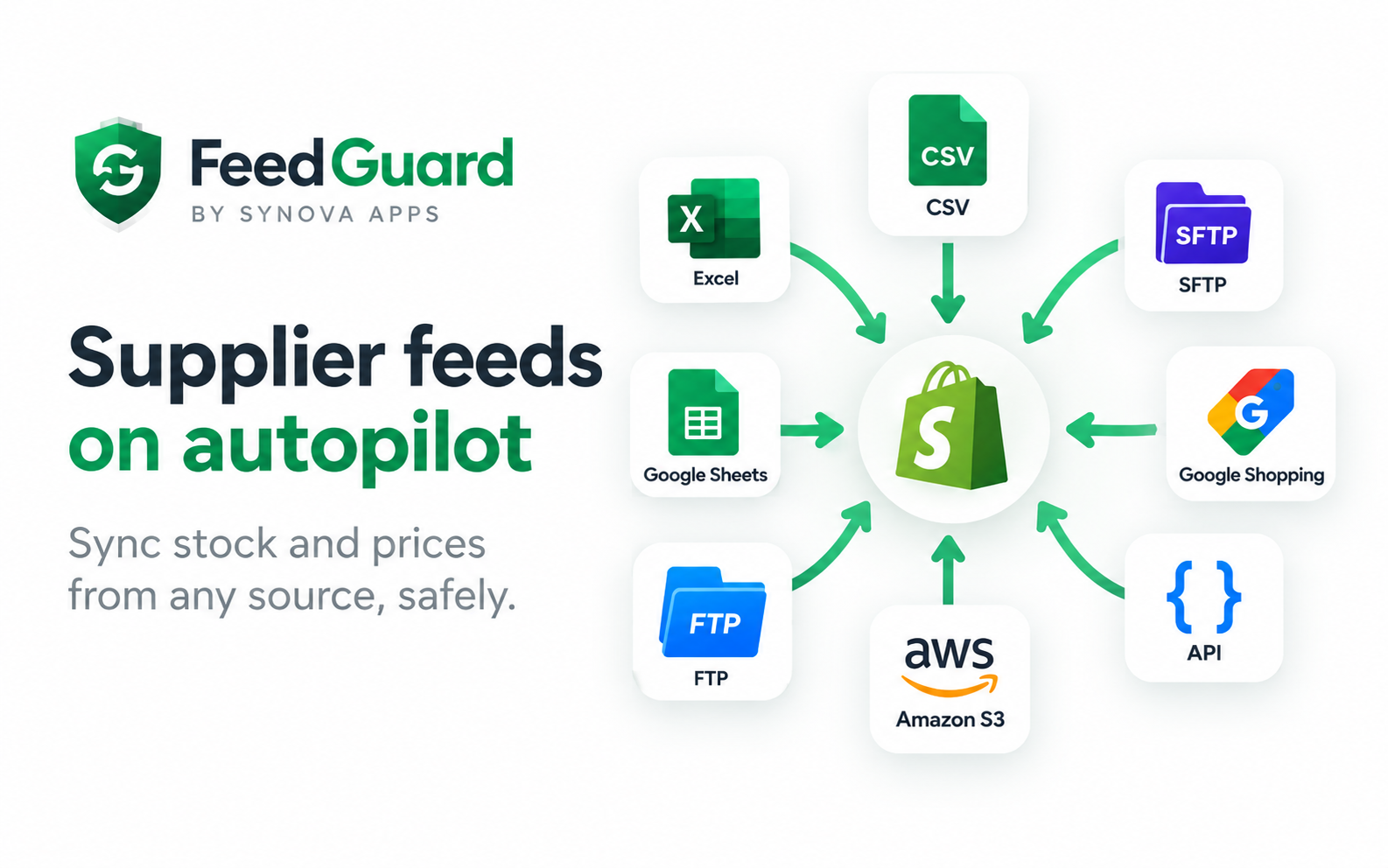
Supplier feeds on autopilot — without the fear. Sync stock and prices from any source, safely.
The sales rep portal Shopify B2B is missing — reps order at contracted pricing, and commissions calculate themselves.
Product registration, serial numbers, and warranty claims — one app, fully automated on Shopify.
A practical framework for deciding whether to buy another SaaS product, configure a low-code tool, or build a custom internal tool, including the costs people forget on both sides.
How AI document processing turns invoice and purchase order PDFs into validated, structured data in your ERP or accounting system, and the checks that keep it accurate.
A fair, practical comparison of n8n, Make, Zapier and custom code for business automation, including how each handles AI steps, scale, hosting and long-term maintenance.
Tell us how it works today. We'll tell you honestly what's worth automating, what it would take, and what it would cost.